1. Peer Podcasts

This
one works well in particular if your students already have a grasp on the
basics of making a podcast, but this is not a requirement. Imagine a large
project is completed - maybe the students have put together their culminating
science fair project, for example. As an additional side-assignment, students
could be responsible for doing an interview-podcast w- they could interview the
classmate whose project was most impressive or eye opening. This benefits
students by giving them experience in a (perhaps) unfamiliar territory, the
auditory modality. Furthermore, this provides a great assessment-as learning
opportunity, as the interviewer performs a form of peer evaluation, while the
interviewee is simultaneously self-evaluating!
2. Background Music


While
this may require some finesse, I've generally been a proponent of allowing
background music in the classroom for long periods of time spent doing
seatwork, or some form of repetitive task. Even if silence is a sign of a
well-managed classroom, said silence can approach uncomfortably boring levels. I
like to offer background music as a reward to my students - a sort of privilege
that can be easily revoked if the classroom ruins it by treating it as an
excuse for misbehaviour, loud voices, etc. It can be motivating for students to
get the chance to choose songs as a reward for good behaviour or diligent work.
It can also be relaxing to throw on some light, introspective instrumental
music that might help students immerse themselves in their creativity, problem
solving, writing, etc. .. Again, the use of music requires careful attention to
its management in terms of rules and responsibilities - but if the class can
get on board with behavioural expectations, it can be a nice way to maintain a
motivated learning atmosphere, and may add some extra enjoyment to the learning
process.
3. Radio Drama
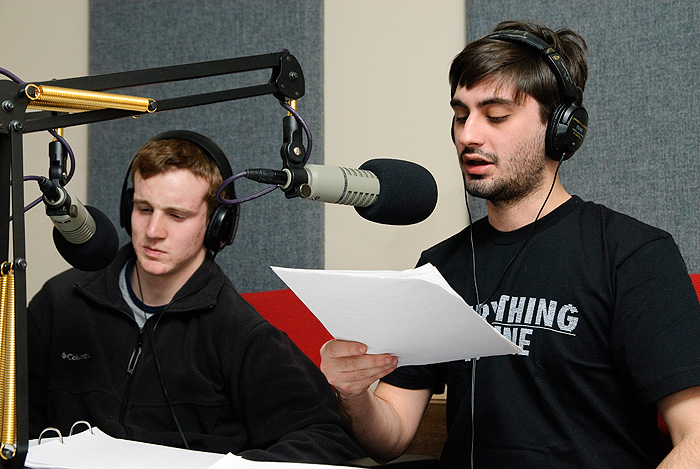
Most students
(and even younger adults) would agree that the idea of listening to radio
dramas is a bit of a lost art. It would be a fool's errand to expect students
to remain engaged listening to any long-form production of this type. However -
they might enjoy making their own. A group project of this sort allows for a
seamless integration of English (creative writing) and Drama (with perhaps a
dash of some computer technique). There's also the problem solving element of
figuring out how to express the story without the aid use of visual cues. I
believe students would enjoy this as a nice twist on conventional, independent
creative writing. Also, their familiarity with their fellow classmates might lend
more enjoyment of listening to the finished projects together. Lastly, it's a
nice form of performance without having to perform it live, which may be
relieving to those students who wish to express themselves and yet struggle
with the challenges of stage fright.
4. Audio Story Readings

Students
could be assigned a "book on tape" to listen to for a novel study or
critical review. Length is of no issue here -what is important is that they are
exposed to a good model of an audio book production. Perhaps they could be
assigned to comment upon the use of voice in terms of pacing, clarity,
enunciation, dynamics - all of which
must be carefully attended to in order to make an audio book sound captivating.
This assignment could culminate in the production of their own audio book. They
could read their own story if available, or a story of reasonable length. By
analyzing spoken language in this manner, students are forced to think about
language in a "meta" sense, and examine the spoken word actively
where we're typically more passive.
5. Radio broadcasts

I've
never tried this, but I can imagine kids having a blast with this one: setting
up a "live" broadcast of a school sporting event, Phys. Ed. event, or
any activity that could require live on-the-scene commentary. This could be
done as an audio-only event to mimic the radio, or could even be extended to
audio-video to mimic a televised event. The key is that the event is recorded live.
This will prove challenging, as puts a person in a position to think on their
feet (ie improvise) and utilize whatever language resources they can muster on
the fly. Afterward, they would have a recording which they could review and
reflect upon - what did I do well, and
where do I need to improve? Much like I believe good estimation skills are
essential to math education (and often underemphasized) , improvisation is a
sort of inexact language skill that I've found is rarely exercised in the classroom.
-------------------------------------------------------------------------------------------------------------------------
If anyone happens to use any of these strategies, or has already done so in the past PLEASE feel free to comment. I'm curious to hear other professional opinions that might add to or modify my perspective on using audio in the classroom!
For further ideas, feel free to check out the lilnk below:
http://taccle2.eu/wp/wp-content/uploads/2013/04/31InterestingWaystoUseAudioinyourClassroom2.pdf
For further ideas, feel free to check out the lilnk below:
http://taccle2.eu/wp/wp-content/uploads/2013/04/31InterestingWaystoUseAudioinyourClassroom2.pdf
The above certainly helped springboard my teacher-brain into creative action.

No comments:
Post a Comment